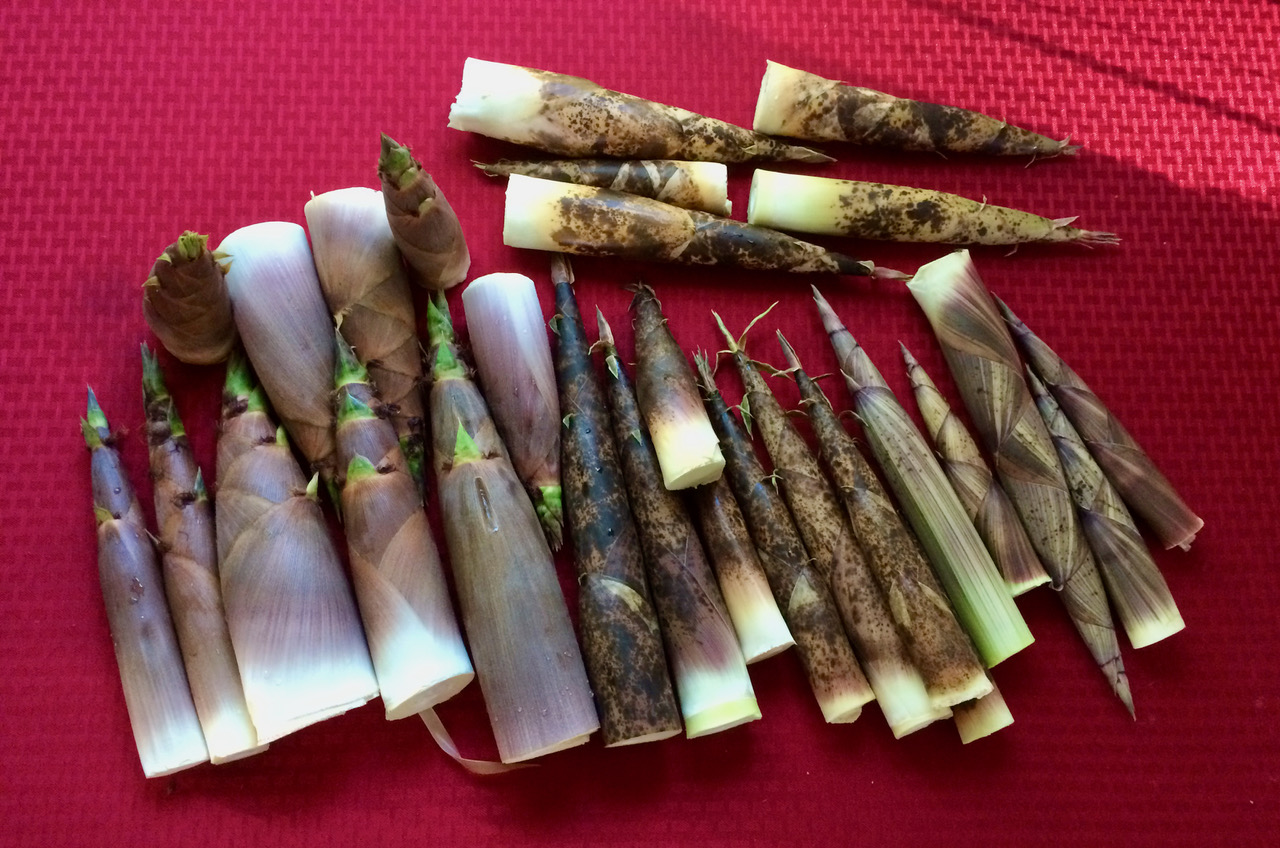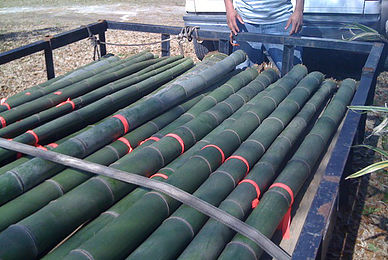
Bamboo is a versatile, income producing crop. You can harvest and
sell bamboo shoots in spring and early summer. You can cut and sell poles in summer or fall.
When you cut the poles you can feed the tops to livestock. They will strip the poles of leaves.
You can run poultry under the bamboo canopy. These birds will eat weeds and the small bamboo
"grass" that comes up. Meanwhile their droppings fertilize the grove. Move them to a new
section as they clear the ground.
Bamboo is a useful plant in addition to its income producing capabilities. It is a perennial.
You don't have to replant it each year. It is evergreen and therefore photosynthesizes year
around. It removes carbon dioxide from the air even in winter. It screens the farm from roads.
It catches runoff from fields. To prevent the rivers in Georgia from running orange, zoning
codes may require a 25 foot setback from streams. Plant bamboo as an income producing buffer
between crops and waterways. Bamboo reduces erosion. It protects fields from wind; catches dust
from field operations. Plant bamboo along swales to prevent gully washes. It is 10 degrees
cooler in a bamboo grove than out in the summer sun. Bamboo thrives on summer moisture and is
greedy for nutrients so it is an excellent crop on which to empty a manure lagoon in summer. As
you thin out leaning canes or broken canes, run them through a shredder. The
resulting mulch is excellent. It can be an additional farm product to sell by the truck load or
bag.
Where Can You Grow Bamboo?
The easy answer is you can grow (temperate) bamboo as a farm crop in USDA Zones 7 and 8. Bamboo
is a forest grass and as such likes humidity. It is not a prairie plant adapted to xeric
conditions. Bamboo grows best with lots of rain in summer, less in winter. Think minimum of 30
inches per year. Bamboo (most bamboos) do not like saturated soils. They are not swamp plants.
Grow bamboo where winters are mild and summers warm and moist. Bamboo is a grass. If your soil
can grow corn, it can grow bamboo.
Videos
http://www.youtube.com/watch?v=eqGbQ159ETg
"How to Harvest Bamboo Shoots"
The president of the SE Chapter of the American Bamboo Society demonstrates how to dig bamboo
shoots.
"Cows
Love Bamboo"
The neighbor's holsteins came to the fence adjoining the groves at Georgia Bamboo. I gave them
gradually bigger poles of bamboo to eat. They loved it.
http://www.youtube.com/watch?v=Z8PnzYheuF4 "Dogs
work the Bamboo"
I am researching yield of bamboo shoots in Georgia. My dogs haul the poles that I thin from my
research plots to the brush pile. See the bamboo chipper in action in Oregon. The
chips are excellent.
http://www.youtube.com/watch?v=oAtcplknAF8 "Bamboo
Shoots in Washington State"
This short film shows the farmer harvesting bamboo shootsand then selling
them at the farmer's market. He talks about selling to restaurants.
http://www.youtube.com/watch?v=RI1rzC9mZdo "Farm
Bamboo for Profit"
This film shows the farmer harvesting shoots, a chef buying shoots and then preparing a bamboo
salad, a customer buying shoots and explaining how she cooks them, and the farmer at his farm
stand discussing his sale of 3 inch diameter shoots to a Japanese
restaurant.
http://www.youtube.com/watch?v=2e2comTK0-8 "Moso
Bamboo on Avery Island"
Avery Island in south Louisiana has 100 acres of bamboo. Every year the Louisiana Gulf Coast
Chapter has a work party to clear the moso bamboo and make it beautiful. See what the groves
look like before and after thinning. Appreciate the work it takes to make an open forest of
timber bamboo.
http://www.youtube.com/watch?v=8Z_ejsKLBRw "Sled
Dogs Pull Bamboo"
This short video shows bamboo poles lashed onto wheels and pulled by sled dogs to the brush
pile where it is off loaded.
http://www.youtube.com/watch?v=OtsIvj6a1ow "Tom
Cogger’s work"
This is a beautifully crafted video about the research on bamboo that is ongoing at WSU
Puyallup, Washington State. Tom Cogger is the son of the chief scientist doing the bamboo work
at WSU. He volunteered to make this movie.
http://www.youtube.com/watch?v=KxrFvA-wp58 WSU
videoshowing unthinned and thinned groves and the work parties thinning them, snow
damage to canes of yellow groove, sheep running to eat bamboo, and chicken tractors on cover
crops.